
















“When technology removes limitations, driving evolves from control to experience.” – Mercedes-Benz
Mercedes-Benz: Revolutionary technology removes the mechanical steering link, delivering enhanced control, comfort, and design flexibility
Mercedes-Benz has introduced a bold leap forward in automotive innovation with the debut of its steer-by-wire technology in the new EQS, marking a transformative moment in the evolution of vehicle control systems.
The breakthrough eliminates the traditional mechanical connection between the steering wheel and the front wheels, replacing it with a fully electronic system that transmits driver inputs via digital signals. This shift enables a fundamentally new way of interacting with the vehicle, enhancing both driving dynamics and user experience.
At the core of this innovation is the concept of translating steering inputs “by wire,” meaning the driver’s commands are processed electronically and delivered to the wheels instantly. This allows the system to adapt steering behaviour dynamically based on speed, driving conditions, and road context, offering a more intuitive and responsive driving experience.
Mercedes-Benz described the technology as a major step towards the future of mobility, highlighting that steer-by-wire is not only about improving steering performance but also about unlocking new possibilities in vehicle design and digital integration.
One of the most immediate benefits is significantly improved manoeuvrability. The system reduces the need for large steering wheel movements, making parking and low-speed navigation far easier, while maintaining stability and precision at higher speeds.
In addition, the absence of a mechanical link allows for greater flexibility in tuning the steering ratio, enabling engineers to optimise both comfort and sportiness—two characteristics that traditionally required compromise.
The innovation also enhances ride comfort by filtering out vibrations from uneven road surfaces, delivering a smoother and more refined driving experience. This digital filtering capability ensures that only relevant feedback is transmitted to the driver, improving both comfort and control.
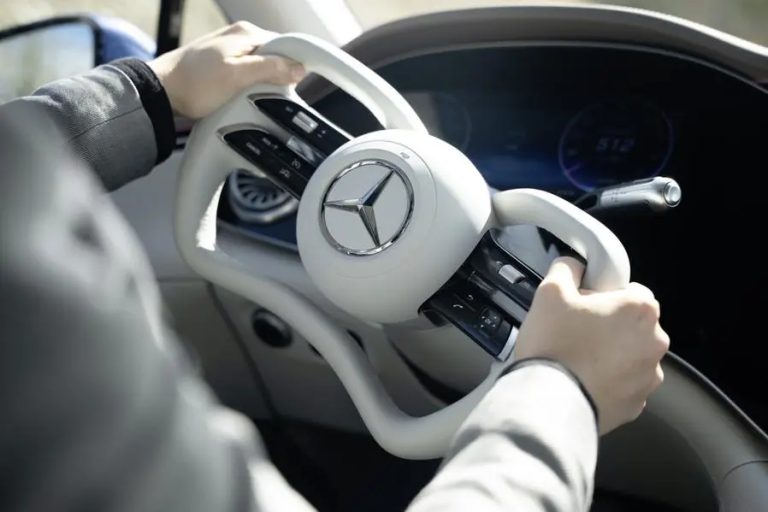
Beyond performance, steer-by-wire introduces new possibilities for interior design. The EQS features a flatter steering wheel, improving visibility of the instrument display and creating a more spacious cabin environment. This design also makes entering and exiting the vehicle easier, reflecting a broader shift towards user-centric vehicle architecture.
Safety remains a key priority in the system’s development. Mercedes-Benz has implemented a redundant architecture, including dual signal paths, advanced sensors, and backup systems, ensuring that steering capability is maintained even in the unlikely event of a system failure.
The system has undergone extensive validation, with over one million kilometres of testing conducted across test benches, proving grounds, and real-world driving conditions. This rigorous testing underscores the brand’s commitment to maintaining its high safety and reliability standards.
Company leadership highlighted that steer-by-wire represents a significant milestone in the transition towards automated and software-defined vehicles. The technology is expected to play a key role in enabling advanced driver assistance systems and future levels of autonomous driving, where seamless interaction between human and machine becomes essential.
Markus Schäfer, Member of the Board of Management of Mercedes-Benz Group AG, indicated that the innovation goes far beyond traditional steering, enabling a new level of immersive in-car experience. He emphasised that the technology will contribute to a more intuitive and engaging interaction between driver and vehicle.
Industry experts note that steer-by-wire has long been considered a futuristic concept, commonly used in aviation systems but rarely implemented in mass-production vehicles. Its introduction in the EQS signals a broader shift in the automotive industry towards fully digital vehicle control systems, where software plays a central role in defining performance and functionality.
The new EQS is expected to be among the first production vehicles from a German manufacturer to feature this technology, setting a new benchmark for innovation in the premium electric vehicle segment.
As automotive technology continues to evolve, the introduction of steer-by-wire underscores Mercedes-Benz’s commitment to pushing the boundaries of engineering and redefining the driving experience.